



New from 18 September 2026: Munich Airport
At all security checkpoints at Munich Airport, the 100ml rule is being scrapped: you'll be able to take single containers of up to 2 litres in your hand luggage, you won't need a clear plastic bag any more, and you won't have to take out liquids or your laptop. Larger containers still need to go in your checked baggage. At other airports and at transfer checkpoints, the 100ml rule generally still applies.
As of: 15 September 2026 · EU-wide security rules on liquids are changing in stages with the introduction of new CT scanners – at Munich Airport, the 100ml rule is being scrapped entirely from 18 September 2026 (details in the box above). We keep updating this article on an ongoing basis – for binding information, please check bundespolizei.de or your departure airport's website before you fly.
How much liquid can you actually take on a plane? And does the 100ml rule still apply in 2026? The answer is: yes – with a few but important exceptions. At some German airports, such as Frankfurt, new CT scanners now mean you can take up to 2 litres of liquid at certain checkpoints. At Munich Airport, this will even apply at all security checkpoints from 18 September 2026 (details in the box above). In this guide, we'll show you which rule applies when, which liquids are allowed without any limit at all, and how to save time at security.
The 100ml rule in hand luggage – how it works
Since 2006, the following has applied across the EU: liquids in hand luggage are only allowed in small quantities. The rule is simple and easy to remember:
Allowed in the 1-litre bag
-
Shampoo & shower gelmax. 100ml per container
-
Toothpaste & mouthwashalso counts as a liquid
-
Deodorant spray, perfumeup to 100ml, can including propellant
-
Liquid make-up, lipstickpowder-based products are exempt
-
Creams, lotion, gelsun cream, hand cream, hair gel
-
Contact lens solutionlarger amounts allowed with a medical certificate
Not allowed in hand luggage
-
Drinks bottles > 100mlfinish or dispose of before security
-
Alcohol > 70% vol.generally banned, even in checked luggage
-
Sprays > 100mlhairspray, insect repellent, cleaning products
-
Lighter fuel, gasdangerous goods – banned outright
-
Nail polish remover (acetone)banned in larger quantities
-
Sauerkraut, yoghurt, soups> 100ml counts as a liquid
Exceptions that are also allowed: baby food in the required amount, essential medication (with a prescription or medical certificate), and duty-free purchases in a sealed STEB bag with the receipt – all three outside of the 1-litre bag.
- Max. 100ml per container (the printed capacity is what counts, not how full it is)
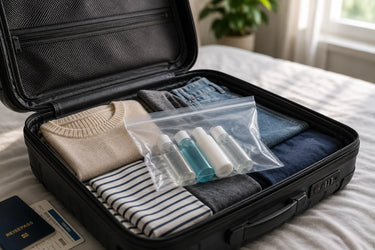
- All containers together in one transparent, resealable plastic bag with a maximum volume of 1 litre
- One bag per person – and it must close completely
- Take the bag separately out of your hand luggage at security and place it in the tray
Important: even if your 200ml container is only half full, it will still be confiscated. What matters is always the printed capacity. It's therefore worth investing in reusable 100ml travel bottles that you can refill before every flight.
What actually counts as a "liquid"?
The term covers more than most people think. According to the Federal Police, everything that is liquid, semi-liquid, gel-like, creamy or of a similar consistency at room temperature falls under the 100ml rule. These are the items most commonly forgotten:
- Toothpaste, hand cream, sun cream, lip balm
- Mascara, nail polish, eyeliner, liquid foundation
- Hair gel, hairspray, mousse, shaving foam, shaving gel
- Roll-on deodorant, deodorant spray, perfume, eau de toilette
- Contact lens solution, eye drops
- Yoghurt, jam, honey, mustard, chocolate spread
- Bottles of water, juice, soft drinks and tea (even opened ones)
- Tins with liquid contents, soups
The 1-litre clear plastic bag – requirements
The bag isn't just a minor detail – it's compulsory. If you can't produce it, your liquids may well end up in the bin. Exception: at Munich Airport, the bag will no longer be required at any security checkpoint from 18 September 2026 (see box above).
- Material: transparent, so the contents are visible
- Volume: maximum 1 litre (approx. 20 × 20cm or 15 × 25cm)
- Closure: resealable (zip or press-seal, not tied in a knot)
- Quantity: one bag per person
- Condition: must close completely – if it bulges, you'll need to repack
Ordinary zip-lock freezer bags work just as well as the officially provided bags at the airport. A reusable flight-bag set is the more sustainable and practical option – many models come with matching refillable bottles.
Exception 1: Baby food
If you're travelling with an infant or toddler, liquids are allowed without a quantity limit, as long as they're needed for the journey:
- Breast milk, infant formula, drinking water for babies
- Liquid baby food (purées, jars, juice)
- More than 100ml per container is also possible
Security staff may carry out random checks, so expect a quick test or a scent check. It's best to declare the baby food yourself when you put it in the tray.
Exception 2: Medication
Liquid medication that you need to take during your trip is also allowed without the 100ml limit. This includes:
- Insulin plus accessories
- Asthma inhalers/sprays
- Nasal sprays, cough syrup, liquid painkillers
- Eye drops, ear drops
- Special dietary products for allergies or medical conditions
Tip: keep medication in its original packaging with the patient information leaflet where possible, and get a short medical certificate from your doctor – this speeds up the check enormously, especially with larger quantities or pre-filled syringes. An English-language certificate is worth its weight in gold for travel outside the EU.
Exception 3: Duty-free purchases (STEB)
Liquids bought in duty-free after security (wine, spirits, perfume, etc.) can be carried in your hand luggage even if they're over 100ml. What matters is the STEB (Security Tamper Evident Bag) – the sealed bag with a red border you receive at the till:
- The bag must not be opened until you reach your final destination
- The receipt must remain visible inside the bag
- If you're transferring outside the EU (e.g. Dubai, Istanbul), the STEB bag may still be confiscated in transit – different rules apply there
- If you're transferring within the EU, declare the sealed bag so it can be repacked into a new STEB
CT scanners: 2 litres at selected checkpoints – and at all checkpoints in Munich from 18.09.2026
Since 2024/2025, several German airports have been using modern computed tomography (CT) scanners that can reliably detect liquids. At these checkpoints, you can carry liquids of up to 2 litres per individual container and no longer need to unpack your laptop or liquids. No airport has officially documented an overall quantity limit per person.
Frankfurt Airport (FRA)
- Most checkpoints in Terminal 1, as well as all checkpoints in Terminal 3, have now switched to CT scanners (up to 2 litres per container)
- The 100ml rule still applies at special and transfer checkpoints, as well as at checkpoints C1/C2/C4/C6
- You can tell whether your lane has a CT scanner from the sign in front of the checkpoint
Munich Airport (MUC)
- From 18 September 2026, the 2-litre limit will apply at all security checkpoints, according to the Bavarian State Ministry and the airport – not just at individual lanes (details in the box above)
- Up until that date, you may still be directed to a conventional lane with the 100ml rule
Note: at most airports, the 2-litre limit only applies at specific approved checkpoints – Munich is the only airport where it will apply across the board at all checkpoints from 18 September 2026. You'll find an overview with primary sources in the table further below. If in doubt, always plan for 100ml so you don't get caught out.
Return flights and connections: why the Munich rule won't help you everywhere
What always matters is the rule at the checkpoint you're currently at – not the one at your departure airport. If you fly out of Munich with a 1.5-litre bottle and then have to go through another security check at your connecting airport, the 100ml rule often applies again there. Frankfurt explicitly states that the 100ml rule still applies at its transfer checkpoints for connecting passengers. At Zurich Airport, the 2-litre limit only applies to passengers departing locally; passengers making a connection have to go through security again under the rules in force there. London Heathrow also explicitly advises travellers to check the rules of the other airport before their return journey. The Bavarian State Ministry therefore recommends that anyone with a connecting flight should find out in advance about the rules in place at their transfer airport.
According to press reports, not officially confirmed by the airport or the ministry: a transfer checkpoint in the satellite building in Munich is reportedly not due to be upgraded until May 2027. Official sources, on the other hand, refer to "all security checkpoints" from 18 September 2026 – we're therefore explicitly flagging this press report as unverified and will update it as soon as there's official confirmation.
Where does what apply? (as of 15 September 2026)
| Airport | Rule | Source |
|---|---|---|
| Munich (MUC) | From 18.09.2026, up to 2l per container at all checkpoints | StMB 14.09.2026 · munich-airport.de |
| Nuremberg (NUE) | Already scrapped since May 2026 (first German airport to do so) | StMB 14.09.2026 |
| Frankfurt (FRA) | Partial: most T1 checkpoints + all T3 checkpoints up to 2l; transfer and special checkpoints as well as C1/C2/C4/C6 still 100ml | frankfurt-airport.com |
| London Heathrow (LHR) | Own UK rule (not EU): Terminals 2–5 up to 2l, no bag needed any more | heathrow.com |
| Dublin (DUB) | 100ml limit scrapped, containers up to 2l, no bag needed any more | dublinairport.com |
| Zurich (ZRH) | Only locally departing passengers up to 2l; transfer checkpoints still 100ml | Zurich Airport Newsroom 22.06.2026 |
| Rome Fiumicino (FCO) | Up to 2l, except for flights to the US and Israel | ENAC 05.08.2025 |
| Milan Linate (LIN) | Up to 2l | ENAC 05.08.2025 |
| Milan Malpensa (MXP) | Terminal 1 up to 2l; Terminal 2 still 100ml (except Fast Track) | ENAC 05.08.2025 |
| Cologne/Bonn (CGN), Vienna (VIE) | According to press reports, central checkpoints have now switched to CT: CGN Terminal 1 fully, VIE at all terminals since 03.07.2026 – both up to 2l – according to press reports, please verify | various media reports 2026 |
| Berlin (BER), Stuttgart (STR) | According to press reports, only partially equipped with CT checkpoints, with the 100ml rule still standard in many areas – according to press reports, please verify | various media reports 2026 |
Provided without guarantee, as of 15 September 2026 – please check the information directly with your departure or transfer airport, or with your airline, before travelling.
Security check: how it works with liquids
- Before the checkpoint: take your flight bag out of your hand luggage and keep it within reach
- In the tray: place the bag open, and declare baby food and medication separately if applicable
- Laptops and large electronics separately (except at CT lanes)
- After the scan: pack the bag away again and head to the gate
You'll save a noticeable amount of time if you pack neatly at home beforehand: just grab your flight bag instead of hastily unpacking in the queue. Travellers flying with hand luggage only benefit from this especially.
What's better off in your checked baggage
Not everything liquid needs to go in your hand luggage at all. For these items, putting them in your checked baggage is usually the more relaxed option:
- Full bottles of shampoo, shower gel and cream
- Olive oil, wine, jars of jam brought back from holiday
- Large perfume bottles
- Cleaning products and detergent (generally recommended)
- Homemade items, if not decanted into 100ml portions
Note: quantity limits for alcohol also apply in checked baggage (over 70% vol. is not permitted; 24–70% is allowed up to 5 litres per person), and lighter fuel, spray canisters and highly flammable products are banned outright.
Comparison: liquids policies by airline
The 100ml rule is the basic EU-wide legal requirement – it generally applies the same way with every airline, regardless of your ticket. Exception: at Munich Airport, the rule – including the 1-litre bag requirement – is scrapped at all security checkpoints from 18 September 2026 (see box above). There are, however, differences in hand luggage size:
| Airline | Liquids rule | Flight bag required |
|---|---|---|
| Ryanair | max. 100ml per container | 1-litre bag |
| Lufthansa | max. 100ml per container | 1-litre bag |
| Eurowings | max. 100ml per container | 1-litre bag |
| Easyjet | max. 100ml per container | 1-litre bag |
| Wizz Air | max. 100ml per container | 1-litre bag |
For the exact hand luggage dimensions of each airline, it's worth checking out our guides: Ryanair hand luggage 2026 and what to expect at the airport.
Checklist: liquids for your next flight
- Buy reusable 100ml bottles or take a set with you
- Decant items into 100ml portions in your toiletry bag (shampoo, shower gel, cream)
- Have your 1-litre zip-lock bag ready
- Pack medication, medical certificate and original packaging
- Travelling with a baby: no quantity limit on food, but mention it at check-in
- Keep duty-free purchases in the STEB bag until you reach your final airport
- At the airport: pack your flight bag at the top of your hand luggage for quick access
Frequently asked questions about liquids in hand luggage
Does the 100ml rule still apply in 2026?
Yes, the 100ml rule is still the EU standard at airports without approved CT technology. Exceptions with larger containers (usually up to 2 litres per container) exist at individual checkpoints, for example in Frankfurt. At Munich Airport, the 100ml rule will be scrapped entirely at all security checkpoints from 18 September 2026 – but for connecting flights via other airports, their own rule will apply again.
Can I take toothpaste or deodorant in my hand luggage?
Yes, provided the container holds a maximum of 100ml. This also applies to creams, gels, hairspray and other paste-like or creamy products. All containers must be packed in the 1-litre clear plastic bag – exception: this won't be required at Munich Airport from 18 September 2026 (see box above), and it's also not required at individual checkpoints at other airports with approved CT scanners (see the table above).
How much liquid can I take for babies?
There's no quantity limit for baby food and breast milk, as long as it's needed during the journey. The same applies to liquid baby food. Security staff may carry out random checks – declare the liquids when you put them in the tray.
What's the rule for liquid medication?
Medication you need during your trip can be taken in hand luggage even over 100ml. Bring it in its original packaging with the patient information leaflet, and ideally a short medical certificate – in English if you're travelling outside the EU.
What happens to duty-free liquids when you have a connection?
Within the EU, you can take them with you in the sealed STEB bag. If you're connecting outside the EU (e.g. Dubai, London, Istanbul), different rules may apply – the STEB bag could be confiscated there. Check your transfer airport's website beforehand.
Can I take an empty water bottle through security?
Yes. A completely empty bottle isn't a liquid and will be accepted. After the checkpoint, you can refill it for free at water fountains at almost every airport – saving both money and plastic.
Does the new 2-litre rule apply to all flights departing from Munich?
For departures from Munich Airport, the Bavarian State Ministry for Housing, Building and Transport confirms that the 100ml rule will be scrapped at all security checkpoints from 18 September 2026. Whether there are any special cases – for example for certain destinations such as the US or Israel, as is the case at Rome Fiumicino Airport – is not officially documented for Munich and therefore not confirmed across the board. For connecting flights via other airports, their own rule applies regardless.
What happens if I depart from Munich but have to connect elsewhere?
The checkpoint at your connecting airport applies its own rule, not Munich's. At many transfer checkpoints – such as in Frankfurt or Zurich – the 100ml rule still applies. Check the rules at your connecting airport before you fly.