





Updated: 22 April 2026 · Power bank rules in aviation change regularly. We update this article continuously – for authoritative information please check lufthansa.com or your airline's website before your flight.
Can I actually take my power bank on the plane? And if so, how large can it be – and where does it go? The short answer: Yes, almost every standard power bank is allowed – but only in carry-on luggage, never in checked baggage. Since 15 January 2026, the Lufthansa Group has significantly tightened the rules for the entire group (Lufthansa, Eurowings, Swiss, Austrian, Brussels). In this guide, we explain all current power bank rules 2026, show you how to convert milliamp hours (mAh) to watt hours (Wh), and what to watch out for at the gate and on board.
Power Bank in Carry-On 2026 – the Most Important Rules
Power banks contain lithium-ion batteries and are therefore classified as dangerous goods (IATA Class 9). Uniform IATA rules are defined worldwide for passenger aviation, though individual airlines can be stricter. The three most important basic rules apply everywhere:
- Transport only in carry-on luggage – never in checked baggage
- Max. 100 Wh (approx. 27,000 mAh) allowed without approval
- 100–160 Wh only with prior airline approval, over 160 Wh generally prohibited
Why never in checked baggage? If a power bank overheats or short-circuits in the cargo hold, the crew cannot respond. In the cabin, however, a fire can be extinguished immediately. Violations are penalised as dangerous goods violations with fines.
Power Bank Capacity: Converting mAh to Wh
Is your power bank flight-approved?
Convert from mAh to Wh in 5 seconds.
Rule of thumb: mAh ÷ 270 ≈ Wh
Most power banks show their capacity in milliamp hours (mAh). Airlines, however, calculate in watt hours (Wh). The conversion formula is simple:
Formula: mAh × Volts ÷ 1000 = Wh
Most power banks use 3.7 V lithium-ion cells. This gives us the rule of thumb:
mAh ÷ 270 ≈ Wh (at 3.7 V)
Example Calculation
- 10,000 mAh × 3.7 V ÷ 1000 = 37 Wh → permitted
- 20,000 mAh × 3.7 V ÷ 1000 = 74 Wh → permitted
- 27,000 mAh × 3.7 V ÷ 1000 = 99.9 Wh → just permitted
- 30,000 mAh × 3.7 V ÷ 1000 = 111 Wh → only with airline approval
- 45,000 mAh × 3.7 V ÷ 1000 = 166 Wh → prohibited
Many modern power banks now have the Wh rating printed directly on the housing – this saves you the calculation. Check before you head to the gate.
Table: Power Banks by Capacity
| Capacity | Wh (at 3.7 V) | Status |
|---|---|---|
| 5,000 mAh | 18.5 Wh | ✓ Permitted |
| 10,000 mAh | 37 Wh | ✓ Permitted |
| 20,000 mAh | 74 Wh | ✓ Permitted |
| 26,800 mAh | 99.2 Wh | ✓ Permitted |
| 30,000 mAh | 111 Wh | ⚠ Only with airline approval |
| 40,000 mAh | 148 Wh | ⚠ Only with airline approval |
| 50,000 mAh | 185 Wh | ✗ Prohibited |
New Lufthansa Group Rules Since 15 January 2026
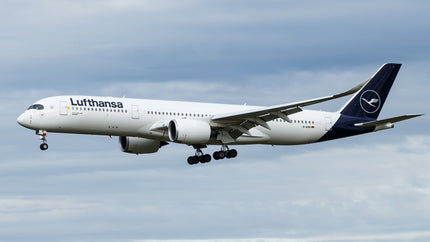
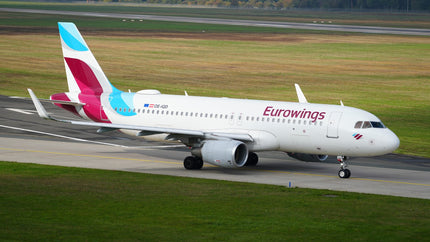
Following several fires caused by overheated power banks in overhead bins, the Lufthansa Group (Lufthansa, Eurowings, Swiss, Austrian Airlines, Brussels Airlines) has significantly tightened the rules. Since 15 January 2026:
- Max. 2 power banks per person – previously up to 20 pieces under 100 Wh
- Only carry in hand luggage, never in checked baggage
- Storage only on your person, in the seat pocket or under the seat in front – NOT in the overhead bin
- Charging and use on board prohibited – also applies to e-cigarettes
- Exception: Power banks for approved medical devices
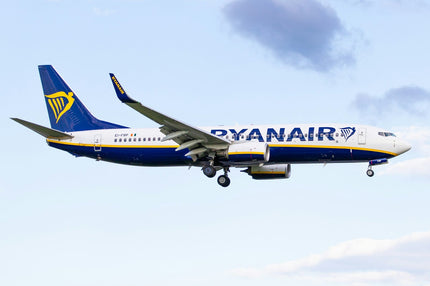
Applies to: Lufthansa, Eurowings, Swiss, Austrian Airlines, Brussels Airlines. Other European airlines like Ryanair and EasyJet still have (as of 04/2026) the more relaxed IATA standards with up to 20 pieces – this could align in 2026 though.
Power Bank Rules Comparison Across All Major Airlines
| Airline | Max. Wh without approval | Max. quantity | Use on board |
|---|---|---|---|
| Lufthansa Group | 100 Wh | 2 pieces | ✗ Prohibited |
| Ryanair | 100 Wh | 20 pieces (IATA standard) | Usually permitted |
| EasyJet | 100 Wh | up to 20 (IATA standard) | Usually permitted |
| British Airways | 100 Wh | 2 pieces (from March 2025) | Restrictions |
| Emirates / Qatar | 100 Wh | IATA standard | With restrictions |
How to Transport Your Power Bank Correctly
1. Proper Storage
- Always in carry-on luggage, never in checked baggage
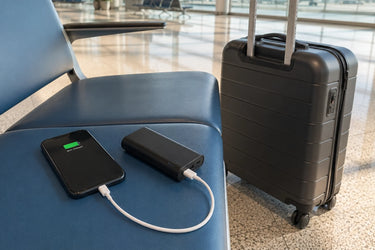
- On your person (trouser pocket, inside jacket pocket) or under the seat in front
- NOT in the overhead luggage compartment
- Cover terminals (for larger power banks with exposed poles) or keep in original packaging
2. Proper Labelling
For power banks without printed Wh ratings, a small sticker with the Wh calculation is recommended – this makes gate checks easier:
- Wh value clearly visible (either printed or via label)
- For power banks between 100–160 Wh: Contact airline before departure and obtain approval
- Carry receipt or proof of purchase if the power bank is new
3. Proper Packing
The safest option is a carry-on bag or a small backpack with its own electronics compartment. Many business trolleys now even have an integrated USB charging compartment with external power bank connection – ideal for travellers who work a lot on the go.
What Happens if Your Power Bank Gets Flagged at the Gate?
If security discovers a power bank that violates the rules, there are three possible scenarios:
- Capacity over 160 Wh: Power bank will be confiscated and disposed of properly. No replacement.
- Capacity 100–160 Wh without approval: Usually the power bank will be returned if you keep it in carry-on luggage and don't use it. Some airlines confiscate even in this case.
- Too many pieces (e.g. 5 × 20,000 mAh with Lufthansa): You must dispose of additional devices at the airport or hand them to acquaintances. The flight will not be refused.
With repeat violations or suspected intentional circumvention of rules, fines can be imposed. The hassle isn't worth it – better to check the capacity beforehand.
Which Power Bank is Worth It for Air Travel?
From an aviation rules perspective, the ideal travel power bank is:
- Capacity: 10,000–20,000 mAh (37–74 Wh) – comfortable enough for 2–5 phone charges, well under the 100 Wh limit
- Wh rating printed directly on housing (saves calculation at the gate)
- USB-C Power Delivery for fast charging of smartphone, tablet and laptop
- Compact dimensions so it fits comfortably in a jacket pocket
- Certification: TÜV, UL or CE for better quality control
Large 40,000 mAh or 50,000 mAh models are intended for camping or emergency power at home – clearly too big for air travel.
What About Other Electronics in Carry-On?
The 100 Wh rule applies not only to power banks, but also to other devices with lithium batteries:
- Laptops: Average 50–90 Wh → permitted
- Tablets, smartphones, e-readers: Well under 100 Wh → permitted
- Camera and drone batteries: Usually under 100 Wh → permitted, secure batteries individually
- E-cigarettes: only in carry-on luggage, never in checked baggage, use on board prohibited
- Model aircraft batteries: Often over 100 Wh – obtain approval beforehand
Power Bank & Liquids – What Fits in Carry-On
Power bank in carry-on is only part of the overall packing puzzle. The most important rules at a glance:
- Liquids: max. 100ml per container, all in 1-litre bag – see Liquids Carry-On Guide
- Carry-on dimensions: vary by airline – see Lufthansa, Ryanair, Eurowings
- Airport procedure: Check-in, security control and boarding – step by step in the Airport Guide
Frequently Asked Questions About Power Banks in Carry-On
Can I take my power bank in carry-on luggage?
Yes, power banks up to 100 Wh (approx. 27,000 mAh at 3.7 V) may be transported in carry-on luggage. Power banks between 100 and 160 Wh require airline approval, over 160 Wh they are generally prohibited. Under no circumstances may the power bank go in checked baggage.
How many power banks can I take?
With the Lufthansa Group (Lufthansa, Eurowings, Swiss, Austrian, Brussels) a maximum of 2 power banks per person has applied since 15 January 2026. With Ryanair, EasyJet and most other airlines, the IATA standard of up to 20 pieces under 100 Wh still applies.
How do I convert mAh to Wh?
The formula is: mAh × Volts ÷ 1000 = Wh. For standard lithium-ion cells with 3.7 V, the rule of thumb is: mAh ÷ 270 ≈ Wh. A 20,000 mAh power bank therefore has around 74 Wh and is easily permitted.
Can I use my power bank on board?
With the Lufthansa Group, the use and charging of power banks as well as e-cigarettes on board has been fundamentally prohibited since 15 January 2026. With other airlines like Ryanair or EasyJet, use is usually permitted as long as the power bank remains in carry-on luggage.
Where do I store the power bank correctly on the plane?
On your person (trouser pocket, jacket pocket), in the seat pocket in front of you or in your carry-on luggage under the seat in front. Never in the overhead luggage compartment – the crew cannot react quickly to a fire there.
What happens if my power bank is too big?
Power banks over 160 Wh will be confiscated at the gate and disposed of properly. For 100–160 Wh, first try requesting approval from the airline before the flight. Without approval, confiscation can also occur here.